
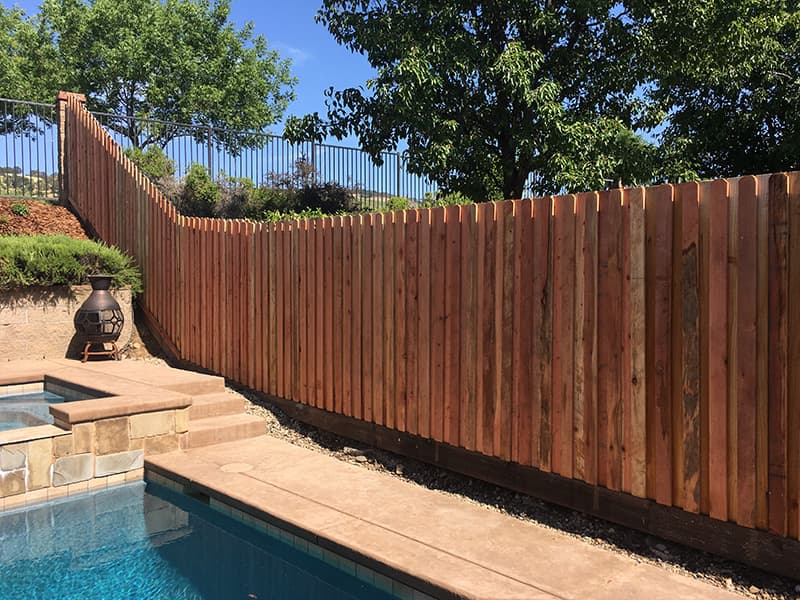
Wood Fence Upgrade Options That Improve Appearance and Longevity
When homeowners start comparing fence bids, the conversation usually comes back to price pretty quickly. That’s understandable. But what I’ve seen over more than 20 years of building fences across Sacramento, Placer, and El Dorado Counties is that the cheapest fence rarely turns out to be the best value. The difference usually comes down to a handful of decisions made during the build, most of which don’t dramatically change the price but significantly change how the fence looks and how long it lasts.
Here are the upgrades I talk through with most of my customers, and what each one actually does for the finished product.
Steel Posts Inside Wood Sleeves
The posts are the foundation of any fence. Everything else is attached to them, so if the posts fail, the fence fails. Wood posts set in concrete will eventually deteriorate at ground level, where moisture, soil contact, and seasonal movement do the most damage. When a post goes, it usually takes a section of fence with it.
Steel posts solve that problem. The steel is set in concrete for a rigid foundation, and a wood sleeve fits over the outside so the fence still looks like a traditional wood fence from every angle. You get the appearance of a wood post with the structural performance of steel. I use a system from Z Post on most of my builds, and the difference in long-term durability is significant. In areas like Folsom, El Dorado Hills, and Granite Bay, where property values are high and homeowners expect fences that hold up, steel posts are one of the first upgrades I recommend.
It’s also worth noting that posts are the least expensive component of a fence relative to what they do. Investing a little more in the foundation is almost always the right call.
Rot Boards
A rot board, also called a kickboard, is a pressure-treated board installed horizontally along the base of the fence, between the posts and just above ground level. The pickets sit on top of it rather than directly in contact with the soil.
Ground contact is where wood fences start to fail first. Moisture wicks up from the soil, insects find easy entry points, and the bottom of the pickets begin to deteriorate long before the rest of the fence shows any wear. A rot board takes that abuse instead, and because it’s pressure-treated, it holds up far better than standard redwood at grade. When it eventually needs replacing, it’s a straightforward repair that doesn’t require pulling the entire fence apart.
For homeowners in Citrus Heights, Rancho Cordova, or anywhere else with clay-heavy soil that holds moisture, a rot board is close to essential. I include it in most of my builds as a standard recommendation.
Decorative Lattice Tops
Adding a lattice section above the main fence body is one of the more visible upgrades available, and it does a couple of things at once. It increases the overall height of the fence, which adds privacy, and it does so in a way that lets light and air through rather than creating a solid wall. The open pattern also gives the fence a more finished, intentional look that reads well from the street.
Lattice tops work particularly well on cap and trim fences, where the framing of the main fence body carries through naturally into the lattice section above. I install these often in Sacramento neighborhoods where homeowners want additional screening from a second-story line of sight without the fence feeling heavy or imposing from the outside.
Cap and Trim Systems
A cap board along the top of the fence and trim boards along the rails give the finished product a level of detail that a basic fence simply doesn’t have. The cap protects the top of the pickets from direct rain exposure, which is one of the first places weathering shows up. The trim pulls the whole structure together visually, covering the rail faces and giving the fence clean, defined lines.
Beyond the aesthetics, a well-built cap and trim system adds structural reinforcement to the fence. The cap ties the tops of the pickets together across each bay, which reduces movement and helps the fence hold its shape over time. For homeowners in Rocklin, Lincoln, or Auburn who are investing in a full yard renovation, cap and trim is often what separates a fence that looks custom from one that looks standard.
Premium Hardware
Hardware is easy to overlook because it’s a small part of the overall cost, but it has an outsized effect on how the fence performs and how long it stays looking right. I use hot-dipped galvanized ring shank nails for the pickets and galvanized fasteners throughout the structural components. These resist corrosion far better than standard fasteners, which means no rust streaking down the fence face as the years go by.
For gates, the hardware choice matters even more. Heavy-duty hinges, properly installed, keep gates aligned and swinging correctly. Lightweight hinges sag. Once a gate starts to sag, the latch stops working properly, and the gate starts dragging. Spending a few dollars more on the right hinges at the start avoids that problem entirely.
Gates and Locking Systems
A gate is the most-used part of any fence, and it deserves the same attention as the rest of the build. Walk gates, drive gates, and double drive gates are all options I build regularly, and each one needs to be framed and hung correctly to operate well long-term. A gate that’s built square, hung on solid posts, and fitted with quality hardware will open and close smoothly for years. One that’s framed too light or hung on posts that weren’t set properly will give you problems quickly.
Locking systems are worth thinking through at the time of installation as well. Options range from simple thumb latches to keyed locks and slide bolts, and the right choice depends on the gate’s location and purpose. A side yard gate with dog access has different needs than a front entry gate. Getting the hardware right the first time is easier than retrofitting it later.
Building It Right From the Start
None of these upgrades are extravagant. Most of them are modest additions to the overall cost of a fence project, but they compound into a finished product that looks noticeably better and holds up significantly longer. If you’re trying to think through what makes sense for your property, our Fence Buyer’s Guide is a good starting point, and our build process page explains how we approach each project from estimate through installation.
For a closer look at the wood fencing options and materials we work with, visit our Wood Fencing page. And if you’re in Sacramento, Placer, or El Dorado County and ready to talk through what the right build looks like for your property, request a free estimate or text or call me directly at (916) 417-5585.
Scott Gregory, A Better Fence Company Inc